For more than a decade, smartphones have been the center of our digital lives. They changed how we communicate, work, shop, learn, and entertain ourselves. But today, something has shifted.
Smartphone innovation has slowed. Annual upgrades feel incremental. User behavior is changing. And behind the scenes, the world’s largest technology companies are already planning for what comes next.
This isn’t speculation. It’s strategy.
The future of technology is being designed beyond smartphones—and it will fundamentally change how humans interact with digital systems.
Why Tech Giants Are Thinking Beyond Smartphones
The smartphone market has reached maturity. Global adoption is high, replacement cycles are longer, and growth has plateaued in many regions. From a business perspective, this creates a problem: platforms that stop growing eventually lose influence.
At the same time, user expectations are evolving:
- People want fewer screens, not more
- Constant notifications are losing their appeal
- Privacy, mental well-being, and frictionless experiences matter more
For companies like Apple, Google, Meta, Microsoft, and Amazon, the key question is no longer how to sell better phones—but what becomes the next primary computing platform.
The Shift Is Not About Devices, It’s About Interfaces
Every major technology era is defined by its interface:
- Desktops introduced the mouse and keyboard
- Smartphones popularized touch
The next era will be different.
The future interface will be:
- Conversational instead of visual
- Context-aware instead of reactive
- Ambient instead of attention-hungry
Rather than opening apps and tapping screens, users will increasingly rely on systems that understand intent, environment, and behavior.
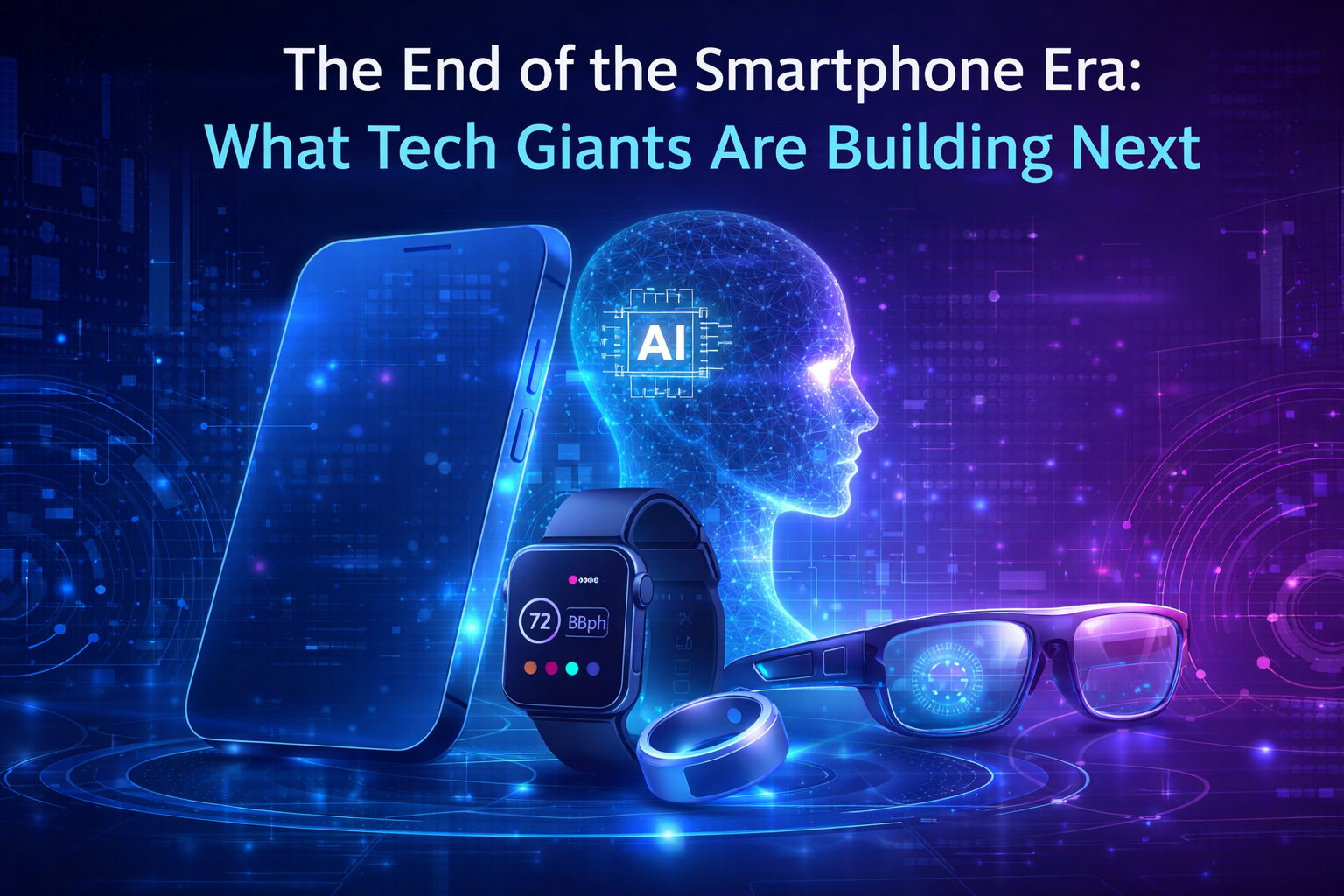
This is where wearables, AI, augmented reality, and ambient computing come in.
Wearables Are Becoming Primary Computing Tools
Wearables are no longer simple accessories. Smartwatches, rings, and health devices are evolving into always-on interfaces that stay close to the body and collect meaningful real-time data.
Their advantage is simple:
- They reduce friction
- They require minimal attention
- They integrate naturally into daily life
Health monitoring, notifications, payments, and contextual assistance are increasingly handled without pulling out a phone. For tech giants, wearables offer a powerful bridge between humans and intelligent systems.
Augmented Reality: Replacing Screens With Context
Augmented reality (AR) represents one of the most ambitious attempts to move beyond smartphones.
Instead of forcing users to look down at a screen, AR overlays digital information onto the physical world. Directions, instructions, messages, and data appear only when needed—and disappear when they’re not.
Major companies are investing heavily in AR glasses and mixed reality platforms because they offer something smartphones cannot: presence without distraction.
While adoption will take time, AR has the potential to redefine how people access information entirely.
Artificial Intelligence Is Becoming the New Interface
Artificial intelligence is not just another feature—it is becoming the operating system of the post-smartphone era.
AI assistants are evolving from simple responders to proactive agents that:
- Anticipate needs
- Automate tasks
- Reduce reliance on apps
Instead of switching between multiple applications, users will increasingly interact with one intelligent layer that handles complexity in the background.
In this model, the question shifts from “Which app should I open?” to “What do I want to achieve?”
That change alone reshapes how technology is built—and how brands are discovered.
Ambient Computing: Technology That Disappears
Ambient computing describes a future where technology blends into the environment rather than demanding attention.
Homes, cars, workplaces, and cities become responsive systems. Devices communicate with each other quietly. Interfaces become invisible.
The goal is not more engagement—but less effort.
For users, this promises convenience and efficiency. For companies, it introduces new responsibilities around privacy, trust, and ethical design.
How Major Tech Companies Are Approaching the Post-Smartphone Era
While tech giants agree that smartphones won’t remain the center forever, their strategies differ:
- Apple focuses on seamless ecosystems, privacy, and hardware-software integration
- Google prioritizes AI-first experiences and contextual intelligence
- Meta is betting on AR and immersive social computing
- Microsoft targets AI-driven productivity beyond traditional screens
- Amazon emphasizes voice, environment control, and embedded commerce
Different paths. Same destination.
What This Shift Means for Consumers
For users, the post-smartphone future offers real benefits:
- Fewer screens and interruptions
- More natural interactions
- Technology that adapts to human behavior
However, it also raises important questions about data ownership, platform dependence, and digital autonomy. As systems become smarter, transparency and control will matter more than ever.
What This Means for Businesses and Marketers
For businesses, this shift is critical.
Traditional discovery models—apps, clicks, and screens—are losing dominance. In an AI-first world, brands must be:
- Understandable to intelligent systems
- Contextually relevant
- Trusted sources of information
SEO is no longer just about rankings. It’s about being recognized, referenced, and recommended by AI-driven interfaces.
Those who adapt early will have a significant advantage.
Are Smartphones Really Disappearing?
No.
Smartphones are not dying—they are being repositioned.
They will remain important hubs, but they will no longer be the primary gateway to technology. Just as desktops didn’t vanish after mobile, phones will coexist with newer interfaces that feel more natural and less intrusive.
The Future Beyond Smartphones Is Already Here
The post-smartphone era will not arrive with a single product launch or announcement. It is unfolding gradually—through wearables, AI, AR, and ambient computing.
The companies shaping this future are not chasing trends. They are redefining how humans and technology coexist.
And the most important shift of all?
Technology is finally learning to get out of the way.
1. Thought Leadership
Stay ahead of the post-smartphone shift.
Follow for insights on how AI, emerging interfaces, and big-tech strategy are reshaping digital experiences.
2. Professional / Business
Still building only for screens?
It’s time to rethink discovery, visibility, and growth in an AI-first world. Start adapting now.
3. Engagement / Share
The smartphone won’t disappear—but its role is changing.
Share this with someone planning for the future of technology and digital strategy.